

Romanización
Contacto e integración romana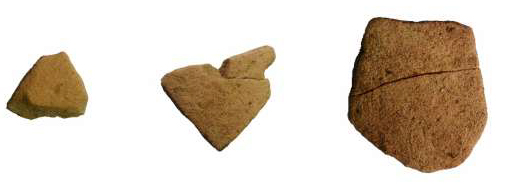
Haltern 70 amphora
Romanización (mediados s. I a.C. – inicios s. II d.C.) Importación romanaThree fragments (two of which refit) belonging to a Baetican amphora of the Haltern 70 type, produced in the Guadalquivir valley for the transport of wine, defrutum (cooked grape must) and olives. The fabrics are sandy, with light ochre colours on the exterior and a darker central core. These containers are the most typical in the Gallaecian hillforts and place the occupation of Croa de Posmarcos within the Baetican-Roman commercial cycle that replaced the earlier Mediterranean Punic one. Its production chronology spans from the mid-1st century BC to the early 2nd century AD, peaking during the Augustan period. Documented in UE203.
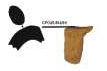
V2-type cup from Lucus Augusti
Romanización tardía (ss. II–IV d.C.) Cerámica común romanaHandle of an individual single-handled drinking cup of V2 type, a characteristic production of the heyday of common Roman pottery from Lucus Augusti (present-day Lugo). Its chronology falls between the mid-2nd century AD and the end of the 4th century AD, although some studies propose that its production began in the 3rd century AD. This piece is the clearest indicator of the continuity of the hillfort's occupation throughout the Roman period, with a presence reaching at least into the Late Empire. Documented in UE201.
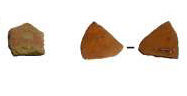
Lucensian slipware
Romanización (ss. I–IV d.C.) Cerámica común romanaBody sherd slipped only on the interior, corresponding to the main red-slipped production of the Lugo (Lucus Augusti) pottery centres, dated between the 1st and 4th centuries AD. The fact that it is slipped only on the interior rules out belonging to the earliest Lucensian productions (imitations of terra sigillata from the first half of the 1st century AD), placing the piece in a later horizon. Documented in UE201.
Idade do Ferro II e III
400 a.C. — séc. I a.C.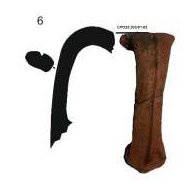
Toralla-type jug
Ferro II / Ferro III (s. III–I a.C.) Cerámica castrexaOne of the most significant pieces from the site. It preserves the handle and the start of the rim, with incised decoration of a vertical line. The Toralla-type jug is a vessel characteristic of the Rías Baixas pottery-producing areas, whose production begins in the 3rd/2nd century BC and peaks between the 2nd and 1st centuries BC. Its presence at Croa de Posmarcos directly links the site to the coastal ceramic tradition of southwestern Gallaecia. Formed by two refitting fragments, documented in UE203 (Trench 200).
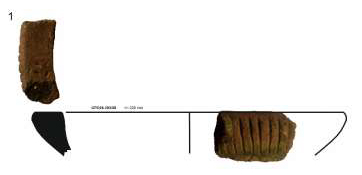
Vigo-type pot
Ferro III (finais s. II a.C. – cambio de era) Cerámica castrexaRim of a classic Vigo-type pot, with a thickened triangular rim, incised vertical line decoration on the exterior and a stamped fish-bone motif on the lip. Together with the Toralla jug, this vessel is one of the clearest indicators of the integration of Croa de Posmarcos into the Rías Baixas pottery region. Its production begins at the end of the 2nd century BC and continues up to the turn of the era. Documented in UE203 (Trench 200).
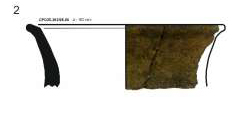
S-profile pot
Ferro III (s. II a.C.) Cerámica castrexaRim of an S-profile pot, a type characterised by a faceted everted rim and a long neck with slightly divergent cylindrical walls transitioning to a carinated body. This type of vessel concentrates its appearance in levels dated to the 2nd century BC, with parallels at sites such as the Alto do Castro hillfort (Cuntis), the Elviña hillfort (A Coruña) and urban contexts like Príncipe 17 (A Coruña). Two refitting fragments, documented in UE203.
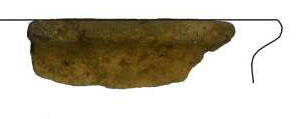
Storage jar with raised flange
Ferro III / Romanización (s. II a.C. – mediados s. I d.C.) Cerámica castrexaRim of a storage jar with a raised flange, corresponding to Martins' form 1c (1987). This type of storage jar is typical of the coastal area of the Rías Baixas, unlike the double-rimmed ones that prevail in the Ártabra region, and appears mostly between the 2nd century BC and the mid-1st century AD. Parallels exist at coastal hillforts such as Montealegre (Moaña). Its presence reinforces the coastal and Atlantic character of the Croa pottery assemblage.
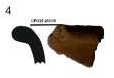
Meridional carinated pot rim
Ferro II / Ferro III Cerámica castrexaRim of a meridional carinated-type pot, one of the most characteristic typologies of Castro-culture pottery. Documented in UE201 (Trench 200), associated with the collapse deposits of the rampart. These vessels have a long chronological duration within the Iron Age II and III context.
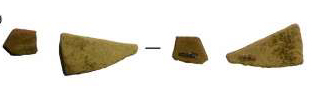
Punic pottery
Ferro III (s. II a.C.) Importación prerromanaBody sherd with refined fabric, yellowish on the exterior and salmon-toned on the internal break, with fine temper lacking quartz or mica —features typical of Punic imports. This type of pottery, abundant in the coastal hillforts of the Rías Baixas and in centres of the Ártabra coast such as the Elviña hillfort, documents a Mediterranean trade cycle that begins in the 2nd century BC and ends with the arrival of Baetican-Roman trade. It is one of the clearest indicators of Croa de Posmarcos's connection to the pre-Roman Atlantic-Mediterranean commercial networks. Documented in UE203.
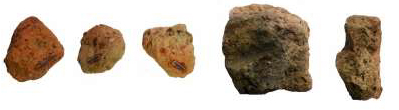
Daub
Idade do Ferro Material construtivoFragments of daub or fired clay with clear imprints of the vegetal framework to which they were attached, direct evidence of the traditional building techniques of the hillforts. At Croa de Posmarcos, two types of paste were documented: type 1, present in trench 300, and type 2, better fired and with compact fabric, concentrated in UE505 of trench 500, where it was probably used in the construction of a combustion structure. The massive presence of daub confirms the existence of domestic buildings not yet excavated.

Schist disc
Idade do Ferro Material líticoDisc made of schist, documented in UE305 (Trench 300), in the only deposit of the site where lithic elements appeared. Its function is uncertain: this type of disc may correspond to vessel lids, gaming pieces, counterweights or tokens. Its presence, together with a thermally-altered polished fragment, complements the scarce but significant lithic assemblage of the campaign.
Substrato natural — Fin da escavación